13.2K
Downloads
45
Episodes
The Innovation Civilization podcast hosted by Waheed Nabeel, and friends of Empasco, features conversations with domain experts on the topics of civilizational progress, technology, history, philosophy, and the first-principles of the ideas that shape our world.
Episodes
Tuesday Jul 20, 2021
Tuesday Jul 20, 2021
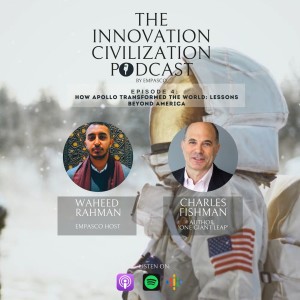
On the 52nd anniversary of the Apollo moon landings, we welcomed New-York Times Best Selling Author Charles Fishman (@cfishman), who wrote the book 'One Giant Leap: The Impossible Mission that flew us to the moon’ (https://www.amazon.com/One-Giant-Leap-Untold-Story/dp/1501106295/). Follow our host Waheed Rahman (@iwaheedo) for more updates on tech and civilization.
We talk about:
- the factors that led to the success of one of the largest government-funded deep-science technology projects.
- spinoff technologies and effects of Apollo on hardware and software we do today
- communist management style vs democratic leadership
- privatisation of space economy, decreasing costs, similarities to internet economy and opportunity for emerging market countries.
- climate change, poverty vs space investment priorities?
Here are the timestamps for the episode. On some podcast players, you should be able to click the timestamp for the episode.
(00:00) - Intro
(09:08) - Key factors that made a major technology project like Apollo successful
(17:25) Evolution of Soviet centralized vs American decentralized management systems
(23:12) - Apollos systemic impact on software
(28:35) - Apollo as a global trust-building exercise for software
(29:02) - Some of the defining spinoff technologies from Apollo
(37:52) - How the context of 50s and 60s defined America and the Apollo mission
(43:03) - Is space travel affordable?
(44:39) - Investing in space technologies vs investing in climate change and poverty
(47:06) - How does space science reinforce climate science?
(48:00) - Is there a new space race on the horizon?
(53:29) - Opportunities for developing nations in the space domain
(58:02) - Space applications within the local context
(64:24) - Outro
Sunday Jun 13, 2021
Sunday Jun 13, 2021
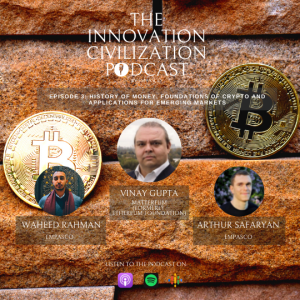
CEO at Mattereum, Vinay Gupta (@leashless), the man who lead the launch of the world's second-biggest cryptocurrency Ethereum at its outset, joins us for a very special third episode on the Innovation Civilization Podcast. We cover the history of money starting from ancient humans to today, the fundamental tech and thesis of crypto along with what emerging market policymakers & citizens can do to leverage this foundational technology. We are also joined by Empasco Partner Artur Safaryan (@asafaryann) and Co-founder Waheed Rahman (@iwaheedo).
Here are the timestamps for the episode. On some podcast players, you should be able to click the timestamp for the episode.
(00:00) - Introduction
(02:36) - Vinay's story on being one of the early adopters of cryptocurrencies
(03:57) - What is a smart contract?
(04:50) - Origins and use of money
(09:42) - Characteristics of money
(11:32) - Digitization of money
(14:10) - Problems with paper money
(16:27) - Who is/are Satoshi Nakamoto?
(19:18) - What is cryptocurrency?
(22:32) - Is cryptocurrency considered as money?
(28:06) - Where are we on the timeline with respect to the radical changes brought about by cryptocurrencies?
(30:46) - What are the missing components for the large-scale adoption of cryptocurrencies?
(38:10) - Is crypto here to make you rich?
(39:11) - Benefits of cyptocurrency
(44:13) - What enabled the rise of cryptocurrencies?
(47:04) - How can governments in emerging markets leverage cryptocurrency for policymaking and state development?
(58:56 ) - How blockchain is currently used in the charity space?
(61:55) - What should individuals in developing nations do to get into the crypto space?
(68:52) - Future of blockchain technology
(71:42) - Outro

Sunday Apr 18, 2021
Sunday Apr 18, 2021
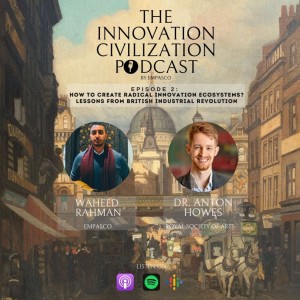
In our second episode, our Co-Founder Waheed Rahman (@iwaheedo) is joined by British historian and author Dr. Anton Howes (@antonhowes) where we uncover the roots of innovation in the modern world, including how to create innovation ecosystems with a focus on 16th-19th century Britain as a case-study.
Dr. Anton is the Head of Innovation Research at The Entrepreneurs Network and released his latest book 'Arts and Minds: How the Royal Society of Arts Changed a Nation'. He's also a former Lecturer in Economic History at King's College London.
OUTLINE:
Here are the timestamps for the episode. On some podcast players, you should be able to click the timestamp to jump to that time.
(00:00) - Introduction to Episode
(01:55) - First-principles: Defining Innovation vs Invention
(07:08) - Industrial Revolution: Why this epoch of time is so crucial in innovation history?
(12:43) - Specific technologies - Idea of different Industrial Revolutions
(15:22) - Innovation in other regions
(16:47) - Key factors that led to an accelerated period of innovation and invention in 16th-century Britain
(22:41) - Scientific Revolution and effects of the Baconian Program on Early Britain during the 1500s and 1600s
(32:44) - Reasons and origins of why the idea of 'improvement mentality' came about
(41:33) - Is Necessity the mother of all inventions?
(48:20) - Effect of British Colonialism in accelerating innovation
(59:03) - Is there a decline in Innovation in Britain vs the American acceleration in the 20th century?
(1:06:09) - Lessons for Emerging Markets when it comes to creating Innovation Ecosystems
(1:14:28) - Ending

Friday Mar 12, 2021
Friday Mar 12, 2021
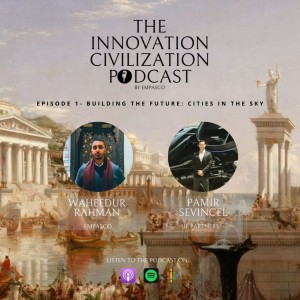
In this first episode, our host Waheedur Rahman (@iwaheedo) is joined by Pamir Sevincel (@pamirsevincel) from Up Partners. The first part of the episode covers the history, formulation, and ontological dimensions of ancient cities. The second part covers the latest developments in the urban air mobility space, solutionizing key 21st-century urban transportation problems, venture models for this foundational eVTOL technology, and the near-term future of cities in the skies.

Sunday Feb 14, 2021
Sunday Feb 14, 2021
A brief prologue to explain the baseline thesis behind the series of episodes that are to follow.