13.2K
Downloads
45
Episodes
The Innovation Civilization podcast hosted by Waheed Nabeel, and friends of Empasco, features conversations with domain experts on the topics of civilizational progress, technology, history, philosophy, and the first-principles of the ideas that shape our world.
Episodes
Saturday Apr 15, 2023
Saturday Apr 15, 2023
Centuries before the official Renaissance of Europe began as we deem it, there was a part of Europe (i.e. Muslim Spain) which already begun the 'Renaissance' and made the region a powerhouse of innovation and prosperity that would go on to shape the world we live in today. A tale of technical innovations, pluralistic cohabiting of various religions, and translation of ideas that formed our modern universities/libraries today.
We uncover a part of history that is often overlooked; our host Waheed Rahman (@iwaheedo), delves into the 700-year Muslim rule in Spain - or Al-Andalus as it was called. He is joined by Dr. Elizabeth Drayson, Emeritus Fellow and Senior Lecturer at the University of Cambridge and author of four books on medieval Spanish history who takes us on a journey through the incredible scientific, cultural, economic, and diplomatic innovations that emerged during this time.
In the episode we cover,
-the rise of Muslim rule in Spain
-the development of science (astronomy, mathematics, agriculture, & medicine, etc.) in Muslim Spain that laid the foundations for all modern innovation and inventions
- Jewish-Muslim-Christian cohabitation and relations in Muslim Spain.
- The 'Golden Age for the Jews' and the tale of Jewish Viziers (Prime ministers) of Islamic emirates
- The Arabic-to-Latin translation movement
- Lessons from 'Convivencia' for the contemporary world
Join us as we uncover the hidden gems of history and showcase the incredible innovations that have shaped our world today.
Follow our host Waheed Rahman (@iwaheedo), for more updates on tech, civilizational growth, progress studies, and emerging markets.
Here are the timestamps for the episode. On some podcast players, you should be able to click the timestamp for the episode.
(00:00) - Intro
(03:15) - The emergence of Islamic Spain or Al-Andalus
(06:07) - The historical significance of the region
(07:49) - Exchange of Knowledge: Golden age of Jews under Muslims
(16:28) - The contribution of Islamic Spain to modern technologies in the fields of scientific development, innovation, politics, & Governance
(25:27) - Knowledge transfer: Importance of the Translation Movement
(34:01) - What were some of the shortcomings or failures of Islamic rule in Spain, and how did they impact its legacy and relevance in modern times?
(38:31) - How can we apply the lessons of historical collaboration and coexistence between different peoples and faiths to address contemporary conflicts and tensions in the world?
(40:58) - Outro
Sunday Feb 26, 2023
Sunday Feb 26, 2023
How to build a digital-native nation? How to use digital-native design to solve voter fraud and corruption?
For an action-packed episode with an actual builder of digital governments, our host Waheed Rahman (@iwaheedo) takes the seat with one of the world’s most influential people in the field of digital governance, Siim Sikkut. (@sikkut) The man who led Estonia’s groundbreaking E-residency program and also played a builder role as the Estonian government’s former Chief Information Officer (CIO). Siim is also the author of the book ‘Digital Government Excellence: Lessons from Effective Digital Leaders” and helps policymakers and technologists around the globe in building future-ready digital societies.
On the episode we cover:
-the fundamentals of building a digital nation
-E-residency, virtual identity programs for non-residents
-Estonian government's technological and legal approach to transforming the country into one of the most advanced digital nations in the world
-strategies and policies needed to launch and steer development initiatives and regulations
-how to use digital design solutions in overcoming issues such as voter fraud, tax fraud, corruption and enabling agile policymaking in government
-how to collaborate with relevant stakeholders on policies concerning technology and digital adoption
-how to use the best practices of scalable startups in innovating solutions for citizens
Follow our host Waheed Rahman (@iwaheedo) for more updates on tech, civilizational growth, progress studies, and emerging markets.
Here are the timestamps for the episode. On some podcast players, you should be able to click the timestamp for the episode.
(00:00) - Intro
(04:05) - Siim's background in digital government
(06:44) - What is the reason for the Tiger Leap Initiative originating in Estonia?
(08:14) - What is unique about the Estonian government's digital Program?
(13:49) - How was the issue of building citizens' trust addressed in Estonia governments' digital program initiatives?
(15:45) - What approaches were taken to address the problem of voter fraud?
(25:25) - What steps were taken to communicate to government stakeholders and ministers that the process was iterative and there was a risk of failure, and how were they convinced of the importance of taking such risks in pursuing e-government progress?
(28:00) - Revenue model of the E-Residency program of Estonia
(33:13) - In what ways were digital solutions leveraged to combat corruption and enhance transparency?
(36:32) - What are the best practices for smaller countries in Asia, Africa, and Latin America that are interested in adopting a more digital government approach similar to the Estonian model?
(43:25) - what approach do you think is more effective for politicians in terms of giving remits and prescriptions to civil servants for technology initiatives?
(45:48) - What lessons can be learned from the failures of digital governments, and what traps do government officials commonly encounter on their digital journeys?
(48:21) - Quick Fire Round
(50:10) - Outro
Saturday Oct 29, 2022
Saturday Oct 29, 2022
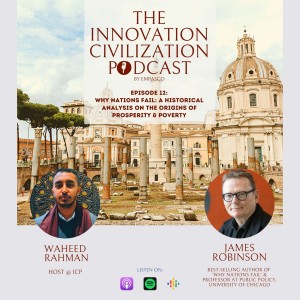
2024 Nobel Prize Winner & Co-author of the best-selling book “Why Nations Fail”, James A. Robinson joined us to discuss the role of political and economic institutions in shaping the success or failure of nations. A political scientist and economist, Robinson is currently a professor at the University of Chicago and one of the world’s leading experts on political and economic development. His research delves into the root causes of poverty, conflict, and economic inequality across the globe.
In the episode, we cover:
-the basics of institution building
-the key differences between inclusive & extractive economic/political institutions and their impact on economies
-what spurred development in some parts of the world and why others lagged behind
-historical context behind what led to the rise and fall of nations
-how to develop sustainable political and economic systems for successful nation building
Follow our host Waheed Rahman (@iwaheedo),, for more updates on tech, civilizational growth, progress studies, and emerging markets.
Here are the timestamps for the episode. On some podcast players, you should be able to click the timestamp for the episode.
(00:00) - Introduction
(05:54) - James's background and what motivated him to study about institutions, economics & nations?
(11:09) - Significance of democracy for nation building
(13:22) - Definition and importance of political/economic institutions
(14:07) - Characteristics of inclusive and extractive institutions
(16:51) - How can political centralization drive economic growth?
(19:41) - Are inclusive institutions more democratic?
(21:02) - Does democracy ensure economic development?
(23:12) - Was the Industrial Revolution the biggest source of inequality in the world?
(28:08) - Examples of nations with extractive forms of institutions
(30:47) - Impact of European Colonialism on poor countries
(35:57) - What sort of political/economic system drove China's economic growth?
(40:36) - Is China's growth sustainable given the current authoritarian regime/institution policies?
(42:56) - How do geography and culture impact economic development?
(48:17) - What do virtuous and vicious circles mean in light of developing political/economic institutions?
(58:05) - Outro
Saturday Jul 23, 2022
Saturday Jul 23, 2022
Founded by the infamous Genghis Khan in 1206, the Mongol Empire created the 2nd largest kingdom in the history of the planet.
What's less well known is that Mongol rule ushered in a plethora of technological innovation and development that shaped the formative years in trade & science infrastructure of a land mass spanning all the way to the East from Korea, through China, Central Asia, Russia, Persia and to even Eastern Europe parts like Crimea and modern day Ukraine.
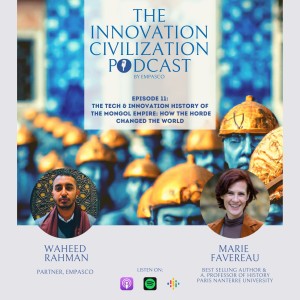
In an attempt to excavate and summarise the lasting impact the Mongol innovation, technology and governance had on the world, Empasco Partner Waheed Rahman (@iwaheedo) sits with historian and Financial Times best-selling author, Marie Favereau. Marie is an Associate Professor of History at Paris Nanterre University. She has been a member of the French Institute of Oriental Archaeology in Cairo, a visiting scholar at the Institute for Advanced Study, and a research associate at the University of Oxford for the major project Nomadic Empires. Her books
include The Horde: How the Mongols Changed the World (https://www.amazon.com/Horde-How-Mongols-Changed-World/dp/0674244214) and the Mamluk Sultanate (published in French) and the graphic novel Genghis Khan.
In the episode we cover:
-the reason for the rise of the Mongol Empire in the 13th & 14th CE.
-long-term innovation view that the Mongols took in terms of funding projects
-the strategies they took to set up the agricultural production and taxation systems throughout the kingdom
-how they built and sustained the system for continuous innovation processes in areas such as astronomy, agriculture, maths, medicine, trade, botany, etc.
-Early forms of democracy in the Mongol empires
Follow our host Waheed Rahman (@iwaheedo) for more updates on tech, civilizational growth, progress studies, and emerging markets.
Here are the timestamps for the episode. On some podcast players, you should be able to click the timestamp for the episode.
(00:00) - Intro
(06:10) - Marie's background & inspiration for writing a book on Mongol innovation and tech history
(08:05) - Who were the Mongols?
(11:08) - What is the "Horde"?
(13:33) - Were the Mongols just people who ravaged and conquered land through coercion and fear-mongering?
(20:10) - What Military technology did the Mongols use?
(27:38) - Mongol innovation,tech,governanace history
(39:36) - Mongol economics
(42:39) - Mongol system of wealth distribution
(43:28) - How did the Mongols manage the Silk Road?
(45:52) - About the creation of the largest integrated market in Pre-modern history
(47:43) - How did the Mongols set up the infrastructure and economy of the cities within the empire?
(52:40) - What was the Mongols' foreign policy to attract new trade and develop connections?
(59:23) - The Mongol land law
(61:25) - How did taxation help with the agricultural production?
(62:30) - What led to the downfall of the Mongol Empire?
(65:26) - Mongol Governance
We made this episode a special listening experience btw.
Mongolian throat singing & classical instruments used:
Yoochin- hammered dulcimer of varying strings struck using two bamboo hammers
Khuuchir- two- or four-stringed instrument with a small sound box
Saturday May 21, 2022
Saturday May 21, 2022
The defining periods in world history have always come about as a result of successful change management and revolutionary leadership. Reflecting on the last 2 decades of rapid flux coupled with
the ongoing global unrest in trade, politics, and commerce arising from a looming global recession, the Ukraine-Russia War and the after-effects of COVID19 calls for a timely occasion on
navigating through the factors leading to successful change management and leadership.
For an educative and thrilling episode on understanding the golden principles of change management and how public and private organizations can thrive in an era of rapid flux, we bring you
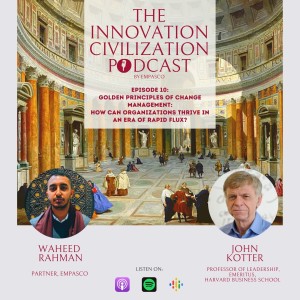
the most revered and one of Time Magazine's top 25 most influential authors ever on business and management - Professor John P. Kotter.(@JohnPKotter) He is the best-selling author, The Konosuke
Matshishita Professor of Leadership, Emeritus at the Harvard Business School, award-winning business and management thought leader and founder of one of the leading management consulting
firms, Kotter International - a leadership management organization for the Global 5000 company leaders. He is the author of 22 books, 12 of them bestsellers - on business, management,
leadership, strategy execution, and transformation and his work has been published in over 150+ foreign languages.
In the episode, we cover:
-how Professor Kotter's 8-step change framework and 8 accelators can be applied in today's management processes
-how private and public organizations can implement and manage change
-the key distinctions between management and leadership
-functions of organizational lifecycles and dual operating system
-how big corporations can incorporate the startup mentality
-whether leadership training is necessary
Follow our host Waheed Rahman (@iwaheedo) for more updates on tech, civilizational growth, progress studies, and emerging markets.
Here are the timestamps for the episode. On some podcast players, you should be able to click the timestamp for the episode.
(00:00) - Intro
(06:26) - Professor John P. Kotter's background
(10:25) - How should modern firm's react to the level of rapid change?
(12:44) - Is the 8-step change model still relevant today?
(15:34) - Is the 8 accelerators similar to the 8-step change framework? What are the accelators needed for?
(16:44) - How to implement and manage change amidst the ever changing nature of work?
(19:47) - Management vs leadership
(29:59) - How are hierarchies and networks connected to the organizational life cycle?
(35:52) - Use case example of dual operating system
(39:19) - How to incorporate a startup mentality in large organizations?
(43:51) - How does change management differ for public vs private organizations?
(46:43) - Rapid-fire round: Getting to know more about the guest
(49:47) - About Professor Kotter's most recent book - "Change"
(52:43) - Can we train people to become better leaders?
(54:20) - Outro
Saturday Apr 09, 2022
Saturday Apr 09, 2022
China boasts the largest fintech ecosystem in the world having a penetration rate of 87% and a total transaction volume of $51.8 trillion via mobile payments only (three times the country’s GDP). The country is setting strong examples for the rest of the world to follow as it continues to develop cashless innovation systems positing road maps and processes for a shared digital currency future.
The largely cashless economy is fundamentally changing the very nature of money as it emerges as the world's financial technology leader.
How are they doing that?
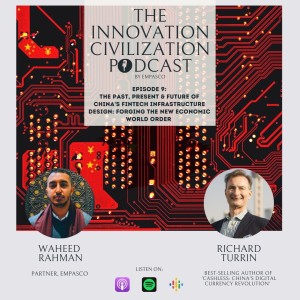
For an exclusive episode unpacking the FinTech infrastructure of China and its growing dominance in the world of tech-driven financial services, we sat down with one of the leading experts in FinTech and Innovations, Rich Turrin.(@richardturrin) Rich is the author of the best-selling books Cashless: China's Digital Currency Revolution (https://www.amazon.com/Cashless-Chinas-Digital-Currency-Revolution/dp/1949642720) and Innovation Lab Excellence. (https://www.amazon.com/Innovation-Lab-Excellence-Digital-Transformation-ebook/dp/B07PMF4YFL) He is an award-winning fintech innovation expert previously heading fintech teams at IBM, following a twenty-year career heading trading teams at global investment banks where he spent a large part of his career in Shanghai witnessing China's cashless revolution upfront.
In the episode we deep-dive into:
-the design and innovation processes that set up the Chinese FinTech infrastructure
-the core reasons behind the massive adaptation of cashless payment systems in China
-how the country incentivized its private tech firms to develop and encourage large scale FinTech solutions by provisioning banking licenses for them
- comparison of NFC payment systems (Square, ApplePay, etc) vs Chinese payment rails (like Alipay)
- QR codes as a tool for widespread fintech adoption in China
-how China's central bank digital currency (CBDC) can transform and replace standard payment systems like SWIFT
-how CBDC differs from ETH/BTC
-how and why the west is falling behind when it comes to fintech
-the rise of CBDCs and policy implications for the Emerging Market countries
Follow our host Waheed Rahman (@iwaheedo) for more updates on tech, civilizational growth, progress studies, and emerging markets.
Here are the timestamps for the episode. On some podcast players, you should be able to click the timestamp for the episode.
(00:00) - Intro
(03:22) - Rich's journey to writing "Cashless: China's Digital Currency Revolution
(05:17) - Key differences between the Chinese society and the American society
(07:51) - Why has the West fallen behind in terms of major fintech adaption vs China?
(11:17) - What is the reason behind the rapid FinTech adoption in China? What makes the Chinese FinTech so special?
(15:56) - What is Central Bank Digital Currency (CBDC)? Why should we care about it?
(21:28) - Emergence of the early cashless payment systems (QR codes, NFC, etc.)
(27:36) - Advantages of having CBDCs compared to the contemporary FinTech payment solutions (Ali Pay, WeChat pay, Apple pay, etc.)
(34:48) - Crypto maximalist viewpoint vs CBDC
(36:00) - Disadvantages to having CBDC
(38:58) - How would CBDCs change/replace the current money transfer system platform such as SWIFT?
(50:36) - Impacts on western policies
(53:24) - When will CBDCs get launched? What stage is it in right now?
(56:03) - How is China breaking the tech industry?
(59:42) - How should policymakers in Emerging/Frontier markets think about CBDCs?
Music used in this episode: Reverie Millenary | by PoKeR、李大白k
(A tune inspired by one of the most famed female figures of ancient China, Empress Wu Zetian. it tells the story of an educated young lady employed in the palace for her academic talents. Through a variety of circumstances and political struggles, she eventually found her way up to the top as the Emperor of Tang Dynasty China, where her talents ushered the ancient kingdom into a golden era of economic momentum.)
Sunday Feb 20, 2022
Sunday Feb 20, 2022
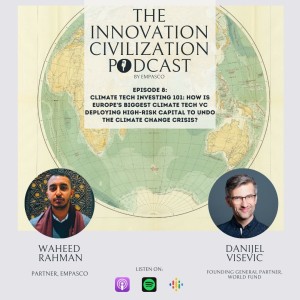
60 gigatons of Carbon Dioxide (Co2) is discharged into the atmosphere every year. Co2 levels are now higher than they have been in at least 800,000 years making climate change the number 1 threat faced by mankind.
What tech to invest in in order to 'unf*** the planet'?
For a momentous & thrilling episode on understanding the successful approach of high-risk tech investing in combatting the climate change crises, our host at Waheed Rahman (@iwaheedo) sat down with Danijel Visevic (@visevic) - the Founding General Partner of World Fund, Europe’s biggest climate tech VC fund.
We cover :
- the fundamentals & purpose of climate tech investing
- the mechanics of a climate tech fund
- how to manage LP expectations
- Key technologies to invest in to undo the effects of climate change
- Climate change policy prescriptions for government
Follow our host Waheed Rahman (@iwaheedo) for more updates on tech, civilizational growth, progress studies, and emerging markets.
Here are the timestamps for the episode. On some podcast players, you should be able to click the timestamp for the episode.
(00:00) - Intro
(03:05) - Danijel's journey to becoming a leading climate tech investor
(05:34) - World Fund's investment thesis for decarbonizing the planet
(07:44) - Distinction between climate tech and clean tech
(09:39) - Climate tech investing fund mechanics
(12:24) - What are the upsides or downsides to being a dedicated fund vs private VCs like Sequoia & SoftBank
(14:31) - The purpose of investing in climate tech
(16:47) - Managing Limited Partner's (LP) expectations - How to prioritize between short-term profit maximization vs sustainability?
(23:28) - Technologies that can help minimize the impact of climate change
(25:07) - What makes Europe the most suitable place for climate tech investing?
(28:11) - The different stages of fundraising for a climate tech startup
(29:50) - How is World Fund developing the climate tech ecosystem in Europe?
(31:13) - Next-generation climate tech innovations to look forward to
(35:25) - What immediate policies can government undertake in mitigating the effect of climate change crises
(40:07) - Outro
Sunday Jan 16, 2022
Sunday Jan 16, 2022
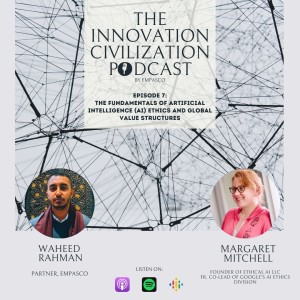
Given how Artificial Intelligence (AI) is eating our civilization, it's essential to sketch out its first principles and ethical dimensions. We are joined by one of the world's leading AI/ML experts in former founder and co-lead at Google's AI ethical division, and the founder of Ethical AI LLC Margaret Mitchell (@mmitchell_ai) who speaks to our Empasco Co-Founder Waheed Rahman (@iwaheedo) on the fundamentals of artificial intelligence ethics and global value structures. Margaret has published more than 50 blockbuster papers on vision-language and grounded language generation concentrating on the evolution of AI towards achieving positive goals. She is vastly famous for her work on the instinctive elimination of undesired biases concerning demographic groups from machine learning models. And her work is utilized by some of the biggest companies in the world. Margaret was also the founding member of Microsoft's ethical AI group.
In this episode, we talk about:
- what is exactly AI?
- what's machine learning vs deep learning?
-the first principles of Ethical AI
-various types of bias and the existence of a 'good' and 'bad' bias as key components to building an AI model
-how governments and policymakers can evaluate ethical AI models
-development of AI in the western world vs the Emerging markets
-the possible utopian, dystopian and realistic predictions of a society fully adopting AI
Follow our host Waheed Rahman (@iwaheedo) for more updates on tech, civilizational growth, progress studies, and emerging markets.
Here are the timestamps for the episode. On some podcast players, you should be able to click the timestamp for the episode.
(00:00) - Intro
(06:03) - Margaret's background on Artificial Intelligence (AI)
(07:55) - Definition of Artificial Intelligence
(09:36) - Difference between Machine Learning & Deep Learning
(11:56) - Ethics in AI (Definition & Practices)
(13:43) - The role of the human layer in Ethical AI
(15:11) - Categories & Examples of biases that occur in AI
(22:29) - Normative vs Descriptive approach for selecting biases in machine learning models
(25:22) - Recent developments in the field of AI
(26:50) - Effective practices of ethical AI in big tech companies
(29:33) - Steps Governments & Policymakers can take to build and regulate AI models
(32:08) - How should tech startups in Emerging Markets develop models in the field of AI ethics?
(35:07) - Future of AI: Utopian vs Dystopian vision
(37:41) - Margaret's recent venture on open source AI
(40:36) - Outro
Saturday Nov 06, 2021
Saturday Nov 06, 2021
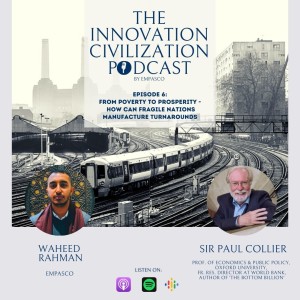
One of the world's foremost development economists Professor Sir Paul Collier from Oxford University, Blavatnik School of Government joins our host Waheed Rahman (@iwaheedo) for this breathtaking episode on poverty alleviation and turnarounds. Sir Paul has previously written 4 books on the topic of poverty alleviation, governance and sustainable growth including one of the most famous books in the development literature called 'The Bottom Billion: Why the Poorest Countries are Failing and What Can Be Done About It'. Prior to this Sir Paul also held the position as the Director of Research at the World Bank.
In this episode we talk about:
-definitions, types and causes of poverty.
-properties of fragile states and the 'bottom billion' people in the world
-how states can manufacture turnarounds including learnings from examples of growing middle-income countries such as Bangladesh, India, Singapore etc.
-where Western institutions working in the development sector get it wrong and how to ameliorate those errors.
-how to achieve good leadership and governance at a state-level.
Follow our host Waheed Rahman (@iwaheedo) for more updates on tech, civilizational growth and progress studies.
Here are the timestamps for the episode. On some podcast players, you should be able to click the timestamp for the episode.
(00:00) - Intro
(06:23) - Humble roots and what made Sir Paul interested in the topics of development economics and governance?
(08:25) - What is poverty? Does poverty always have to relate with a financial benchmark? What are the types and causes of poverty?
(10:37) - Who are the "Bottom Billion"?
(12:11) - what are the structural traps to poverty that Bottom Billion countries have?
(22:13) - How do the Western institutions allocate capital for the development sector?
(26:43) - What role do the World Bank and other financial institutions play to bolster infrastructure building?
(30:26) - How can states manufacture turnarounds?
(38:16) - How do countries like Bangladesh and other developing states continue to grow (autopilot development) despite high number of corruption and poverty?
(42:13) - Are we on the right trajectory in terms of alleviating poverty? What roles do the government and state leaders have to establish strong societies?
(46:16) - Outro
Saturday Sep 11, 2021
Saturday Sep 11, 2021
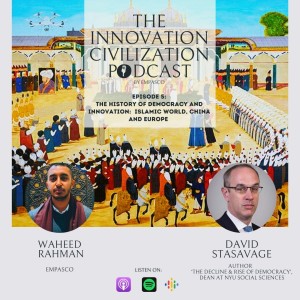
We're joined by the Dean of Social Sciences at New York University and Professor of Political Science David Stasavage (@stasavage) who wrote the recent book (The Decline and Rise of Democracy). We talk about:
- the first principles and definitions of what we exactly mean by 'democracy'
- a compressed summary of the origins, and pre-17th century non-European early forms of democracy in the Islamic world, China, Africa.
- democracy, institution-building, and state development in early Rashidun Caliphates, Umayyads and Chinese empires.
- Does adopting democracy automatically lead to more economic development and innovation?
- The reasons for the development of late democracy in Europe.
- The reasons for development of the democratic model in the United States.
- Technology and the future of democracy in the world.
Follow our host Waheed Rahman (@iwaheedo) for more updates on tech and civilization.
Here are the timestamps for the episode. On some podcast players, you should be able to click the timestamp for the episode.
(00:00) - Episode intro and key moments
(04:55) - Why David wrote a book on the history of Democracy across different regions?
(05:52) - Definitions and first principles of Democracy.
(07:10) - Is democracy a consensus-based system?
(07:45) - First principles of early vs modern democracy
(08:58) - Examples of early democracy across the world
(09:32) - Compressed summary of the origins of democracy till today
(11:20) - The role of democracy between 7th and 13th CE Islamic world
(14:08) - How decentralised system of governance made democracy possible?
(15:15) - Democratic process of the early Rashidun caliphates
(16:30) - Standardization and unification of democratic policies
(17:11) - How is China's political development different from the rest of Europe and the Islamic world
(21:41) - How is democracy tied to the idea of economic development?
(24:30) - The role of democracy when it comes to technological innovations
(25:48) - Emergence of democracy in Europe
(28:09) - Why were Aristotle's democratic discussions more popular in Europe than in the rest of the world
(29:31) - Impact of Aristotle's democratic theory on early Europe
(30:23) - Does democracy help reduce inequality?
(35:50) - What is bureaucracy?
(37:49) - Mixtures model of democracy
(39:25) - Are there hierarchies in a modern democracy?
(41:54) - Does democracy change forms?
(45:04) - Is autocracy deeply rooted in the culture of political and state development?
(47:14) - Development of the democratic model in the US and the future of democracy
(49:48) - Outro