13.2K
Downloads
45
Episodes
The Innovation Civilization podcast hosted by Waheed Nabeel, and friends of Empasco, features conversations with domain experts on the topics of civilizational progress, technology, history, philosophy, and the first-principles of the ideas that shape our world.
Episodes
Saturday Mar 29, 2025
Saturday Mar 29, 2025
Friday Mar 14, 2025
Friday Mar 14, 2025
(00:00) - Intro
(01:27) - What is decentralized science, and how does it challenge traditional research models?
(03:25) - What inefficiencies in traditional science does decentralized science aim to solve?
(05:31) - How is decentralized science redefining intellectual property in research and innovation?
(12:18) - In today’s fast-moving biotech landscape, does drug exclusivity still hold up for 20 years?
(19:18) - Are early-stage anti-aging drugs the future of longevity science?
(24:09) - How does decentralized science ensure research credibility and scientific rigor?
(26: 08) - In a world of fractionalized IP, how do researchers protect and govern their innovations?
(31:53) - Is decentralized science a revolution or just another crypto scam?
(33:47) - Can long-term scientific research thrive in the fast-paced, hype-driven crypto market?
(44:42) - How can decentralized science integrate with traditional research institutions and publishing models?
(47:44) – What career paths and recognition exist for researchers in decentralized science?
Saturday Mar 01, 2025
Saturday Mar 01, 2025
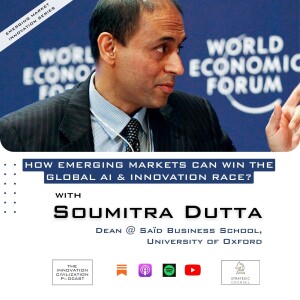
Innovation is often seen as the driving force behind economic growth, but how can emerging markets build successful innovation ecosystems? We explore the key ingredients required to foster innovation at a national level.
Soumitra Dutta has worked at the intersection of academia, business, and policy, serving as the Dean of leading business schools and advising governments on how to create innovation-driven economies. He shares key insights on how emerging markets can learn from global success stories and adapt them to their own unique environments.
We dive deep into:
• Defining Innovation: How innovation differs from invention and why successful market adoption is key.
• National Innovation Strategies: Why political leadership plays a crucial role in fostering innovation.
• The Role of Governments: How government policies, procurement, and infrastructure investments can catalyze innovation.
• Emerging Market Leadership: Lessons from countries like Singapore, China, and Finland on transforming national economies.
• The Role of Talent: Why attracting, developing, and retaining skilled professionals is critical for sustainable innovation.
• Measuring Innovation: A breakdown of the Global Innovation Index and how emerging markets can climb the rankings.
• Collaboration vs. Competition: Why innovation thrives in open, knowledge-sharing ecosystems.
Key Takeaways from the Episode:
1. Innovation Requires Strong Leadership:
Countries that successfully foster innovation have strong political leadership that prioritizes R&D, education, and infrastructure.
2. Government as an Enabler:
From providing financial incentives to setting up digital infrastructure, how governments can play a key role in ensuring businesses and entrepreneurs can innovate effectively.
3. Why Emerging Markets Need a Unique Strategy:
Instead of mimicking Silicon Valley, emerging markets must leverage their strengths, such as market-driven innovations and regulatory flexibility.
4. The Importance of Talent & Immigration:
Nations that attract and retain top talent consistently outperform others in innovation. Policies that make it easier for skilled professionals to relocate can accelerate growth.
5. Learning from China & Singapore:
China’s strategic long-term investment in innovation and Singapore’s structured approach to attracting businesses provide models that other emerging markets can adapt.
6. Infrastructure as a Foundation:
A strong innovation ecosystem needs reliable digital and physical infrastructure, including roads, internet connectivity, and financial systems.
7. The Power of KPIs and Measurement:
Innovation must be measured effectively—governments should not just aim to climb rankings but use metrics to improve their weakest links.
8. Open Innovation & Collaboration:
The best innovation economies prioritize knowledge-sharing and open-source development over isolationist policies.
Timestamps:
(00:00) – Introduction to Soumitra Dutta and the Emerging Market Innovation Series
(02:10) – What is innovation? Breaking down invention vs. market adoption
(05:30) – Why and what kind of government policies are critical for innovation success
(10:20) – Lessons from Singapore, China, and Finland on scaling innovation
(18:45) – How to achieve leadership & cross-ministry collaboration in national innovation
(25:10) – How AI and blockchain are reshaping innovation ecosystems at national levels
(30:40) – The importance of attracting top talent to drive innovation
(36:50) – Measuring innovation: How the Global Innovation Index works
(42:30) – The need for systemic change to improve education, healthcare, and digital infrastructure
(50:10) – Why collaboration is more important than competition in driving innovation
(56:30) – Closing thoughts and final advice for emerging market leaders
Join us in this compelling discussion with Soumitra Dutta, where we uncover the building blocks of national innovation ecosystems and how emerging markets can thrive in the new global economy.
Follow our host on Linkedln to know more or subscribe to our emailing list to get new episodes directly into your inbox.
This episode is part of the Emerging Market Innovation Series, produced in collaboration with Strategic Counsel.
Sunday Feb 16, 2025
Sunday Feb 16, 2025
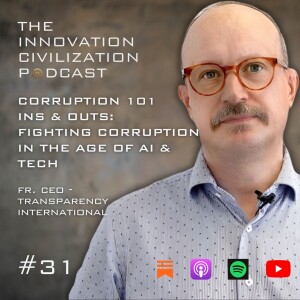
In this episode, we sat down with Daniel Eriksson, former CEO of Transparency International, to explore how corruption operates globally and what can be done to combat it.
Corruption is one of the most pervasive challenges facing the world today. But how do we dismantle it, especially when it's deeply entrenched in political systems?
Daniel has spearheaded anti-corruption initiatives across more than 100 countries, leading advocacy efforts to challenge corrupt systems, promote transparency, and hold the powerful accountable. From state capture to the misuse of emerging technologies, he sheds light on how corruption evolves and how we can fight back.
We dive deep into:
Understanding Corruption: Breaking down the types of corruption, from petty bribery to grand corruption and state capture.
The Role of Transparency International: How TI’s Corruption Perception Index works and its impact on global anti-corruption efforts.
Global North’s Role in Enabling Corruption: How countries like the UK and Switzerland facilitate money laundering from the Global South.
Emerging Technologies in the Fight Against Corruption: The potential of AI and blockchain to detect and prevent corrupt practices.
Success Stories: How Ukraine’s digital transformation has made it a leading example in anti-corruption during wartime.
Key Takeaways from the Episode:
1. Corruption Defined: Daniel Eriksson explains corruption as the abuse of entrusted power for personal gain, highlighting its various forms, from petty corruption to state capture.
2. Transparency as a Cure: Open data, digital public procurement, and accessible financial records are key to minimizing corruption, especially in high-risk sectors like defense and real estate.
3. The Global North’s Responsibility: Wealth stolen from the Global South often ends up in the Global North. Daniel calls for stronger regulations to prevent money laundering through real estate, anonymous shell companies, and financial systems.
4. The Power of AI and Blockchain: While blockchain remains underutilized, AI holds promise in analyzing large datasets to uncover hidden corruption, though challenges remain in its adoption.
5. Ukraine’s Anti-Corruption Journey: Despite being at war, Ukraine has climbed Transparency International’s corruption rankings through citizen-driven efforts, digitalization, and political will.
6. Challenges for Transitioning Countries: For countries like Bangladesh undergoing political transitions, Daniel advises focusing on high-impact sectors like public procurement to build transparency and trust.
7. Fighting State Capture: Addressing corruption at the highest levels requires systemic change, from legal reforms to digital transparency measures.
8. A Call for Global Action: Daniel emphasizes the need for democratic countries to block dirty money inflows and support global anti-corruption initiatives.
Join us in this compelling conversation with Daniel Eriksson as we explore the complexities of corruption and the tools we need to fight it.
Follow our host (@iwaheedo) for more insights on governance, transparency, and global development.
Timestamps:
(00:00) - Intro
(02:12) - What is Transparency International and how does it fight global corruption?
(03:07) - Is rooting out corruption the key to solving challenges in emerging markets?
(07:05) - What separates legal lobbying from political power hijacking and corruption?
(09:37) - How is the Corruption Perceptions Index constructed and what is it used for?
(12:00) - Is there a link between corruption, lack of democracy, and weak institutions?
(16:26) - Has global corruption increased, decreased, or remained the same over the past century?
(18:05) - What is the cause of state capture corruption?
(19:31) - How are emerging technologies reshaping the fight against corruption?
(22:30) - Is blockchain transforming anti-corruption efforts with smart contracts and transparency?
(29:08) - Can online tendering reduce corruption by increasing transparency?
(30:30) - What government data should be open or closed to minimize corruption?
(33:02) - Are large language models (LLMs) being used to combat corruption?
(39:02) - Is the future of anti-corruption driven by grassroots citizen efforts or top-down government initiatives?
(39:52) - What advice would you give to leaders of transition countries fighting corruption?
(44:38) - Does systemic anti-corruption reform focus on laws, people, or processes?
(47:49) - How can democratic leaders manage opposing forces when tackling systemic corruption?
(49:25) - How effective are anti-corruption commissions in fighting systemic corruption?
(52:12) - Could a national public dashboard of KPIs and finances revolutionize government transparency?
(57:09) - Do global north countries have incentives to stop illicit money inflows from corrupt elites?
(59:50) - Outro
Sunday Feb 02, 2025
Sunday Feb 02, 2025
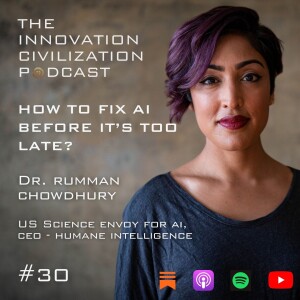
We're joined by the US Science Envoy for AI, Dr.Rumman Chowdhury, who's a leading expert in responsible AI. We uncover the ethical, technical, and societal implications of artificial intelligence.
As AI rapidly eats up the world, the question is what happens when it doesn’t align with human values? How do we navigate the risks of bias, misinformation, and hallucination in AI systems?
Dr. Chowdhury has been at the forefront of AI governance, red teaming, and AI risk mitigation. She has worked with global institutions, governments, and tech companies to make AI more accountable, safe, and equitable.
From her time at Twitter’s (now X) Machine Learning Ethics Transparency and Accountability team to founding Humane Intelligence, she has actively shaped policies that determine how AI interacts with human society.
We dive deep into:
- AI bias, disinformation, and manipulation: How AI models inherit human biases and what we can do about it.
- Hallucinations in AI: Why generative AI models fabricate information and why it’s not a bug but a feature.
- AI governance and regulation: Why unchecked AI development is dangerous, and the urgent need for independent audits.
- The risks of OpenAI, Meta, and big tech dominance: Who is really in control of AI, and how can we ensure fair oversight?
- How companies should approach AI ethics: Practical strategies businesses can use to prevent harm while innovating responsibly.
Key Takeaways from the Episode:
1. AI as a Tool, Not a Mind:
Dr. Rumman Chowdhury debunks the myth that AI is alive or sentient. AI is a tool—just like a hammer—it can be used to build or destroy. The real issue isn’t AI itself, but how humans choose to use it.
2. Why AI Hallucinations Are Unavoidable:
Unlike traditional machine learning models, generative AI doesn’t compute facts; it predicts what words statistically fit together. This means hallucinations—where AI completely fabricates information—are not a flaw, but an inherent feature of how these models work.
3. The Hidden Biases in AI Models:
AI models are only as good as their training data, which often reflects human biases. Dr. Chowdhury discusses how AI systems unintentionally amplify biases in hiring, finance, and law enforcement, and what needs to be done to fix it.
4. The Illusion of AI Objectivity:
Many assume AI models are neutral, but the truth is that all models are built with human input, which means they carry subjective biases. Dr. Chowdhury warns that the real danger is allowing a handful of tech elites to dictate how AI shapes global narratives.
5. The Need for AI Red Teaming & Auditing:
Just like cybersecurity stress tests, AI models need independent stress tests to identify risks before they cause harm. Dr. Chowdhury shares her experience leading global AI red teaming exercises with scientists and governments to assess AI’s real-world impact.
6. OpenAI and the Power Problem:
Is OpenAI truly aligned with public interest? Dr. Chowdhury critiques how AI giants hold more power than entire nations and explains why AI must be treated as a public utility rather than a corporate monopoly.
7. Why AI Needs More Public Oversight:
Most AI governance is self-imposed by the companies that build these models. Dr. Chowdhury calls for third-party, independent AI audits, similar to financial auditing, to ensure transparency and accountability in AI decision-making.
8. The Role of Governments vs. Private AI Firms:
With AI development largely controlled by private companies, what role should governments play? Dr. Chowdhury argues that governments must create AI Safety Institutes, set up national regulations, and empower independent researchers to hold AI accountable.
Timestamps:
(00:00) - Introduction to Dr. Rumman Chowdhury and AI ethics
(03:03) - Why AI is just a tool (and how it’s being misused)
(04:58) - The difference between machine learning, deep learning, and generative AI
(07:43) - Why AI hallucinations will never fully go away
(11:46) - AI misinformation and the challenge of verifying truth
(13:26) - The ethical risks of OpenAI and Meta’s control over AI
(18:20) - The role of red teaming in stress-testing AI models
(30:26) - Should AI be treated as a public utility?
(35:43) - Government vs. private AI oversight—who should regulate AI?
(37:22) - The case for third-party AI audits
(53:51) - The future of AI governance and accountability
(61:03) - Closing thoughts and how AI can be a force for good
Join us in this deep dive into the world of AI ethics, accountability, and governance with one of the field’s top leaders.
Follow our host (@iwaheedo) for more insights on technology, civilization, and the future of AI.
Saturday Nov 02, 2024
Saturday Nov 02, 2024
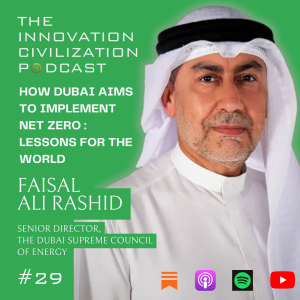
We welcome Faisal Ali Rashid, Sr. Director at the Dubai Supreme Council of Energy, to learn from Dubai's ambitious drive toward achieving net zero by 2050. Faisal, a leader in energy strategy and sustainability, oversees programs transforming Dubai’s approach to energy, water, and waste management, setting a new standard for urban sustainability in the region.
We were also joined by our friend on the podcast, Tushar Narula - a sustainability advisor and a climate change expert whose work has spanned different continents, industries, and top institutions like UC Berkeley, MIT, Harvard, & Imperial College London.
In this episode, Faisal shares Dubai’s comprehensive strategies for renewable energy and demand-side management, revealing key milestones like achieving 25% renewable energy in the total energy mix and aiming for 100% renewable energy by 2050. He explains not only the WHAT but HOW Dubai plans to achieve these in detail.
We also discuss the Dubai Supreme Council of Energy’s regulatory framework, incentive programs, and innovative public-private partnerships (PPPs) that fund green projects, including the groundbreaking Mohammed bin Rashid Al Maktoum Solar Park. Faisal highlights the role of community involvement and youth leadership in advancing sustainability, describing how the Advancing Net Zero initiative empowers the next generation to contribute to Dubai’s climate goals.
All the topics covered in the episode:
-Dubai’s Renewable Energy Goals: Achievements and future targets toward 100% renewable energy.
-Demand-Side Management: Reducing consumption and increasing energy efficiency.
-Policy and Financial Incentives: How Dubai fosters sustainable development through strategic regulations and PPPs.
-Innovation and Technology: Cutting-edge projects in solar, smart metering, and energy storage.
-Community and Youth Engagement: The role of education and volunteerism in driving net-zero progress.
Join us as we dive into Dubai’s pioneering efforts to build a sustainable, net-zero future with one of its leading energy strategists.
Follow our host, Waheed Rahman (@iwaheedo), for more updates on tech, civilizational growth, progress studies, and emerging markets.
Timestamps:
(00:00) - Intro
(02:30) - Faisal’s background and Dubai’s sustainability journey
(03:58) - Demand-side management and green building initiatives
(05:47) - Dubai’s renewable energy milestones and 2050 goals
(09:38) - Policy and incentives driving green transition in the middle east
(18:43) - The role of PPPs in funding sustainability projects
(24:12) - Dubai’s innovation in energy storage and technology
(32:33) - Key lessons for global cities on climate action
(38:33) - Youth and community involvement in net-zero goals
(41:28) - Outro
Friday Sep 27, 2024
Friday Sep 27, 2024
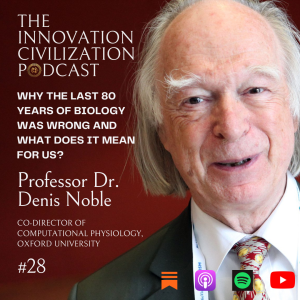
We're joined by Dr. Denis Noble, Professor Emeritus of Cardiovascular Physiology at the University of Oxford, and the father of 'systems biology'. He is known for his groundbreaking creation of the first mathematical model of the heart's electrical activity in the 1960s which radically transformed our understanding of the heart.
Dr. Noble’s contributions have revolutionized our understanding of cardiac function and the broader field of biology. His work continues to challenge long-standing biological concepts, including gene-centric views like Neo-Darwinism.
In this episode, Dr. Noble discusses his critiques of fundamental biological theories that have shaped science for over 80 years, such as the gene self-replication model and the Weissmann barrier. He advocates for a more holistic, systems-based approach to biology, where genes, cells, and their environments interact in complex networks rather than a one-way deterministic process.
We dive deep into Dr. Noble's argument that biology needs to move beyond reductionist views, emphasizing that life is more than just the sum of its genetic code. He explains how AI struggles to replicate even simple biological systems, and how biology’s complexity suggests that life’s logic lies not in DNA alone but in the entire organism.
The conversation covers his thoughts on the flaws of Neo-Darwinism, the influence of environmental factors on evolution, and the future of biology as a field that recognizes the interaction between nature and nurture. We also explore the implications of his work for health and longevity, and how common perspectives on genetics might need rethinking.
All the topics we covered in the episode:
-The critique of Neo-Darwinism and the future of evolutionary theory.
-Systems biology: Understanding life beyond the gene.
-The complexity of biology: Why reductionism falls short.
-Evolution and inheritance: The role of environment in shaping species.
-Health implications of Dr. Noble’s work: Longevity, lifestyle, and the limits of genome-based predictions.
Join us for a thrilling discussion on the future of biology, evolution, and the practical implications for health and science.
Follow our host, Waheed Rahman (@iwaheedo), for more updates on tech, civilizational growth, progress studies, and emerging markets.
Timestamps:
(00:00) - Intro
(03:04) - Why Was The Last 80 Years of Biology Wrong?
(08:17) - Where does Logic come from?
(13:03) - Is Evolution Truly Random or Driven by Purpose?
(22:05) - Is Nurture more important than Nature?
(29:06) - Denis Noble calls for a rewrite of all Biology textbooks
(32:48) - Is Neo-Darwinism Just a Model? Understanding the Difference Between Evolution and the Creationism Debate
(39:22) - Natural Selection vs. Lamarckian Evolution: How Darwin Changed Our Understanding of Survival Traits
(46:03) - Reductionism vs. Integrationism in Science: How the 'Third Way' Challenges Neo-Darwinism
(49:43) - What Does Epigenetics Mean for the Average Person? How Denis Noble's Paradigm Shift Impacts Everyday Health and Life?
(69:29) - Is Western Science Facing a Paradigm Shift? Rethinking How We Determine Truth and Health in Light of Eastern and Western Influences
(75:21) - Why Reductionism Dominates Science: The Political and Practical Challenges of Embracing a Systems Biology Approach
(82:49) - Can We Trust AI to Behave Ethically? The Need to Connect Philosophy with Technology in AI Development
(86:46) - Outro
Sunday Aug 25, 2024
Sunday Aug 25, 2024
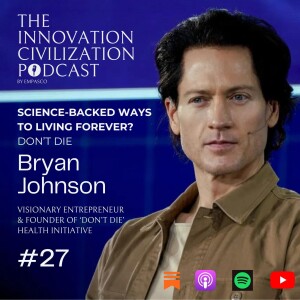
We welcome Bryan Johnson, multi-millionaire visionary entrepreneur and founder of "Don't Die." Known as the most measured man in human history, Bryan is pushing the boundaries of human longevity by meticulously tracking his body's biomarkers in pursuit of an extended health span, not just lifespan. His 'Blueprint' protocols can be found here.
Bryan's journey from revolutionizing digital payments with Braintree Venmo, which he sold to PayPal for $800 million, to dedicating over $100 million of his fortune to extend human life reveals a deep commitment to humanity's future. Through his initiative Blueprint, Bryan is developing an algorithm that takes better care of our bodies than we can do ourselves, aiming for a world where "Don't Die" becomes a societal mantra.
In this episode, Bryan discusses his philosophy behind "Don't Die" and how it could reshape politics, economics, ethics, and more. He explores the potential of AI to revolutionize decision-making and extend human capabilities beyond our current limitations. Bryan also put forward the challenges of aligning AI with human longevity and the ethical dilemmas that arise when pursuing extended life spans.
The conversation spans topics such as the future of artificial intelligence, the exploration of human consciousness, and the need for societal shifts toward sustainable living. Bryan talks about the potential of technology to transform our understanding of life and offers a visionary perspective on what humanity might look like in the 25th century.
We also cover how Bryan’s work could redefine what it means to be human, the importance of mastering the basics of health, and the potential for algorithms to outperform human decision-making in every aspect of life.
All the topics that we covered in the episode:
-Health and Longevity: Bryan's quest to extend life through science and technology.
-AI and Human Potential: Artificial intelligence's role in shaping humanity's future.
-Societal Transformation: How "Don't Die" could redefine our approach to politics, ethics, and economics.
-Consciousness and Technology: Exploring the next frontier of human experience.
-Ethical Challenges: The dilemmas of aligning AI with human longevity.
Join us for a forward-thinking discussion as we explore the intersection of technology, longevity, and the future of civilization with one of the leading minds in the field.
Follow our host, Waheed Rahman (@iwaheedo), for more updates on tech, civilizational growth, progress studies, and emerging markets.
Here are the timestamps for the episode. On some podcast players, you should be able to click the timestamp for the episode:
(02:56) - Bryan's background and the origins of "Don't Die"
(07:57) - Living with a future-oriented mindset and connecting the dots retrospectively
(09:41) - Trust in science through the use of biomarkers and objective data as a source of truth
(11:15) - The philosophical motivations behind pursuing rejuvenation science and the desire to live forever despite not fearing death
(14:37) - Why might humanity's progress in decision-making and societal improvements not continue at the same rate despite past achievements?
(17:51) - Reflecting on the idea that 'Don't die' is the greatest virtue, contrasting it with the ethical teachings of philosophers like Socrates, Confucius, and Plato
(19:47) - How does the paradigm shift of 'don't die' impact all actions and social structures and confront the influence of AI-driven recommendation systems on personal behavior?
(21:54) - The contrast between inherent human nature, whether inherently good or bad and the internal conflict between different versions of ourselves, like 'evening Brian' and 'morning Brian?
(25:36) - Discussing whether the goal of the Blueprint is to achieve a consistently performing self across different times and situations
(27:54) - Reflecting on the overemphasis on material goals like financial success and questioning their true impact on long-term happiness
(29:40) - The mental orientation needed to optimize for longevity, balancing material gains with a higher purpose and finding the best mindset to subscribe to
(31:14) - How Stoicism and similar philosophies suggest that dissociating from base desires leads to personal freedom and an optimized self, including firing 'Evening Brian.'
Sunday Jul 28, 2024
Sunday Jul 28, 2024
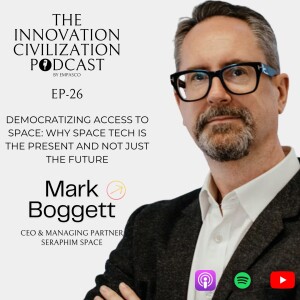
We welcome Mark Boggett, CEO and co-founder of Seraphim Space, Europe's biggest Space tech fund and the world's first space-focused investment fund
Mark's journey from a career in technology investment to pioneering space venture capital reveals the transformative potential of space tech for our civilization.
Mark's expertise is rooted in his careful monitoring of SpaceX's revolutionary impact on the market, inspiring him to establish Seraphim Space. With significant investments in over 120 space tech companies, including cutting-edge startups like iSci and Hubble Network, Mark shares invaluable insights into the industry's future.
Mark discusses Seraphim's unique approach to investment, focusing on seed and Series A stages, and highlights their accelerator program, which has become the largest space tech accelerator in the world. He elaborates on how Seraphim supports startups, from early-stage university spinouts to scaling established companies, ensuring they are investment-ready and poised for success.
The conversation explores the evolution of space tech, the rise of miniaturized satellites, and the potential for space tech to revolutionize various sectors, including defense, climate, and sustainability. Mark sheds light on the economic and strategic importance of space tech, the role of government R&D, and the impact of global geopolitics on the industry.
We also cover the ethical considerations and regulatory challenges surrounding space tech, emphasizing the importance of sustainable development and the potential for space tech to create a healthier and more resilient planet.
All the topics that we covered in the episode:
* Tech Industry Evolution: Mark's journey from tech investment to pioneering space venture capital.
* Venture Capital Dynamics: Seraphim's investment philosophy and support for startups.
* Space Tech Innovations: Advancements in miniaturized satellites and digital infrastructure.
* Market Conditions and Job Impact: The economic and strategic importance of space tech.
* Future of Space Applications: The transformative potential of space tech in various sectors.
* Regulatory Environment: Challenges and opportunities in space tech regulation.
Join us for an enlightening discussion as we explore the future of space technology with one of the industry's leading investors.
Follow our host, Waheed Rahman (@iwaheedo), for more updates on tech, civilizational growth, progress studies, and emerging markets.
Here are the timestamps for the episode. On some podcast players, you should be able to click the timestamp for the episode.
(00:00) - Intro
(01:42) - Mark's background and career journey
(03:09) - Seraphim's investment philosophy and framework
(04:17) - Investment stages and focus areas
(07:35) - Supporting startups post-investment
(11:05) - Space tech innovation waves, market dynamics, and investment landscape
(14:59) - Large constellations of miniaturized satellites
(19:07) - Future potential of space applications
(23:27) - Future direction of space tech regulation
(27:30) - Innovative business models in the space tech industry
(35:15) - LLMs & Space Tech are revolutionizing modern applications & technology
(41:42) - Need for Government-funded R&D in space tech.
(51:52) - Space tech's role in planetary sustainability
(56:29) - Outro
Sunday Jun 23, 2024
Sunday Jun 23, 2024
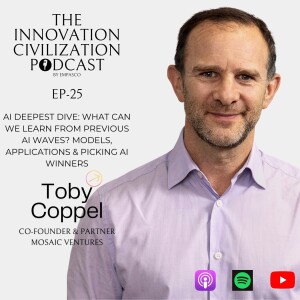
We're joined by Toby Coppel, Founder and General Partner at Mosaic Ventures, who has been investing in the last multiple waves of AI.
Toby's extensive career spans iconic firms like Netscape, AOL, & Yahoo, leading up to his current role at Mosaic Ventures, a prominent venture capital firm. He has been instrumental in significant investments, including a billion-dollar investment in Alibaba that yielded an $80 billion return for Yahoo shareholders. Toby provides an insider's perspective on the tech landscape, sharing invaluable lessons from his experiences with industry giants like Jerry Yang, Jack Ma, and Richard Branson.
Toby elaborates on Mosaic's investment philosophy, highlighting their focus on Series A and late seed-stage investments. He explains how Mosaic supports startups post-investment, emphasizing their hands-on approach and commitment to founder success. Toby also discusses Mosaic's thematic investment strategy, particularly in the realm of machine learning applications, where they have been active since 2016.
The conversation navigates through various waves of AI innovation, from early computer vision applications to the current era of generative AI and large language models. Toby shares his views on the evolving AI landscape, the challenges of training models, and the competitive dynamics of the AI industry.
We also explore the potential impact of AI on the job market, the ethical considerations surrounding AI use, and the importance of regulation in fostering innovation while ensuring safety. Toby offers his insights on the future of AI applications, emphasizing the transformative potential of AI in consumer and enterprise contexts.
Below is a quick synopsis of all the topics we cover:
Tech Industry Evolution: Insights from Toby's career in tech, including significant investments and strategic decisions.
Venture Capital Dynamics: Mosaic's unique approach to supporting startups and their focus on Series A investments.
AI Innovations: A comprehensive look at the waves of AI advancements and the current state of AI technology.
Market Conditions and Job Impact: Analysis of AI's impact on the job market and the ethical considerations involved.
Future of AI Applications: Exploration of the potential for AI in consumer and enterprise applications.
Regulatory Environment: The role of regulation in the development and deployment of AI technologies.
Join us for an enlightening discussion as we explore the intersections of technology, venture capital, and AI with one of the industry's most experienced investors.
Follow me, (@iwaheedo), for more updates on tech, civilizational growth, progress studies, and emerging markets.
Here are the timestamps for the episode. On some podcast players, you should be able to click the timestamp for the episode.
(00:00) - Intro
(02:50) - Toby's background and career journey
(06:19) - Mosaic's investment philosophy and framework
(08:17) - Investment stages and focus areas
(08:53) - Supporting startups post-investment
(09:45) - AI innovation waves and market dynamics
(13:00) - Current AI landscape and competitive dynamics
(17:15) - AI Investment Landscape and Mosaic's positions
(23:30) - Large Language Model (LLM) - based Applications
(36:23) - Future potential of AI applications
(42:11) - Future direction of copyright protections for training data
(45:46) - How Generative AI might reduce the cost of building applications?
(49:31) - Impact of Generative AI on traditional job roles
(52:48) - Europe's current position on AI
(56:26) - Regulation in AI and its implications
(61:43) - Outro